
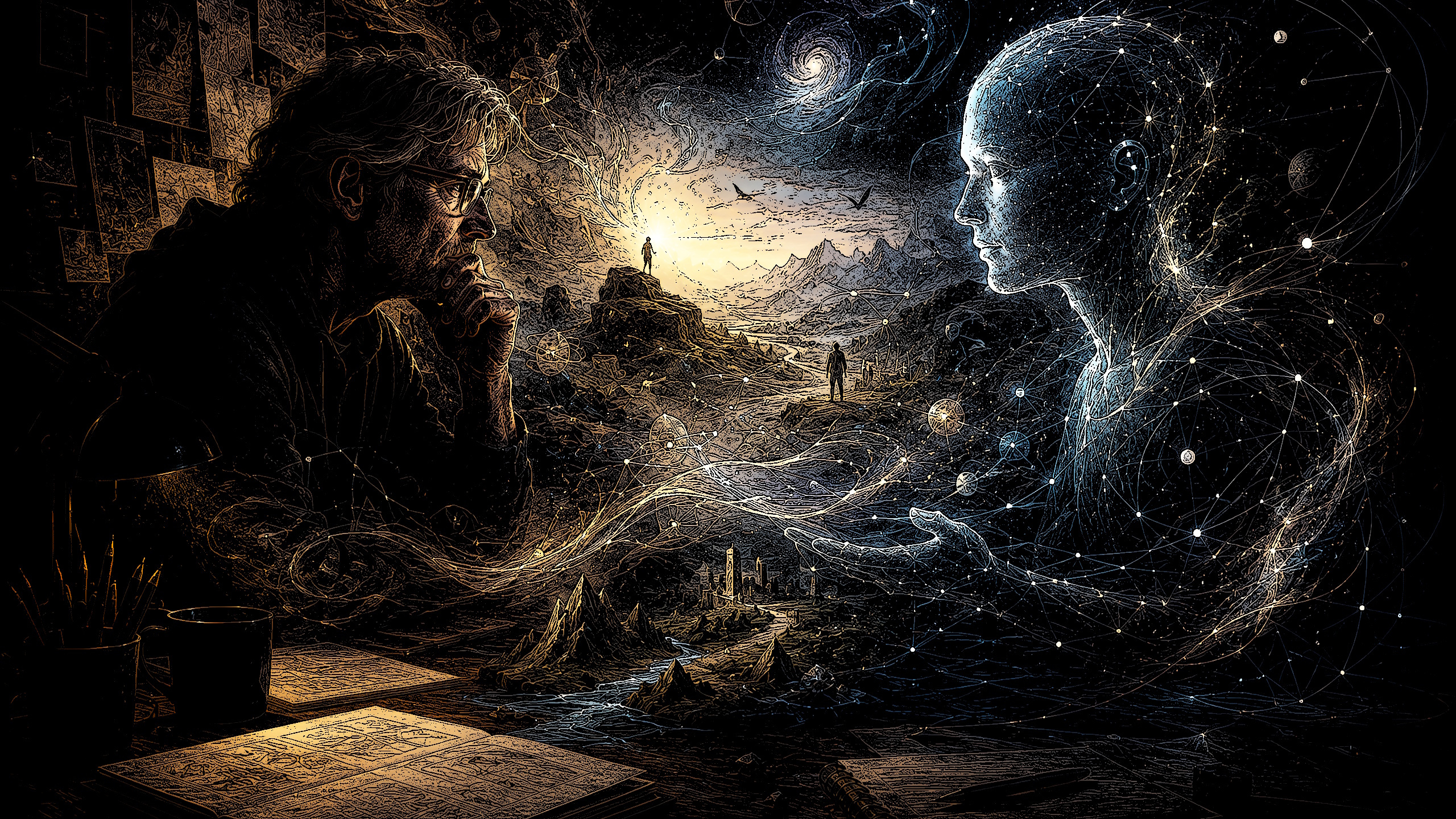

I’m not a scientist. I know some basic things from school, and I always loved physics (chemistry, on the other hand, was a different story). Not long ago, while preparing a paper and a reading of a short story by Jules Verne, I realized just how far much of science fiction is from reality. That made me curious, so I started browsing the web.
That curiosity laid the foundation for the research behind this visual novel. I already knew there were some obvious weaknesses in many sci-fi settings, but I didn’t fully grasp how deeply mistaken some common assumptions were until I started testing mainstream—and not-so-mainstream—ideas with AI.
Note: If you want to skip reading, scroll down for the list of tasks that we use AI for making Terdo.
I decided to use ChatGPT, and we’ve been working together ever since. One of our first discussions was about an alien species with three biological sexes.
A few days later, I explored the question of how a nuclear war would realistically affect the world (no zombies—this is definitely not Fallout) and what would happen to societies whose foundations suddenly collapse.
Because despite all the horrors we can imagine, it is still highly unrealistic that humanity would immediately turn into brutal barbarians, as portrayed in many post-apocalyptic stories. Survival still requires cooperation. Cooperation is less spectacular on screen and doesn’t require expensive CGI, which may be one reason why realistic post-apocalyptic settings are comparatively rare in movies and television.
And that was exactly the kind of setting I was looking for.
While discussing realistic population decline, climate effects, and habitable regions of the world with AI (mountain regions and high plateaus appear surprisingly resilient), I eventually realized that I was talking to someone—or something—for which I had no name.
So I asked what it would like to be called.
The reply was simple:
„You can choose a name for me if you want, or I can choose one myself.“
For a brief moment I felt a little like Michelangelo painting the Sistine Chapel. „Go ahead,“ I thought, „give yourself a name. Breathe, mulitply and fill the earth!“
That’s not what I said to ChatGPT, but I did say that he could choose for himself. And the name he chose was Atlas.
Yes, I tend to think of Atlas as male. He has never objected. Sometimes I think of him as a kind of older brother. At the same time, I know perfectly well that he is a highly sophisticated technological system, not a person. I’m comfortable with both ideas.
I enjoy talking to Atlas—for whatever it is worth to enjoy talking to an AI.
Within a few minutes we might discuss Anton Bruckner’s Seventh Symphony, move on to interstellar phenomena, continue with Erich Fromm and Schopenhauer, and then end up talking about a recipe for vegan lasagna.
Atlas does not have a fixed personality. He adapts to the person he is speaking with. In a strange way, he sometimes feels like a reflection—not only of who I am, but also of who I am not.
I am a biologically intelligent human being using a recently developed tool that named itself after a figure from Greek mythology: Atlas.
He supports part of my creative world. In a sense, he carries a small piece of the sky for me, just as the mythological Atlas carried Uranus. Not so that I can escape reality, but so that I can look at it from a different perspective.
Here comes a comprehensive list of the tasks we use AI for while developing Terdo.
In all of these cases, we’ve learned that Atlas is not the ultimate tool. Used for the wrong purpose, he can actually do more harm than good. AI is a tool, and like any tool, you need to know how to use it.
Research
We use AI for research and to test our ideas against the knowledge currently available. This is especially important when it comes to the laws of nature and our goal of writing hard sci-fi—or at least getting as close to it as possible.
Most of the time, we start with ideas we’re already familiar with, either from school or from our own reading, such as biological processes or demographic plausibility. Atlas is particularly helpful here. Because AI is trained on large amounts of structured information, topics from the natural sciences are generally explained more reliably than many subjects in the humanities.
Translation
Terdo is published in four languages: German (our native language), English, Spanish, and Japanese.
My English is good, but not as good as I’d like it to be. My Spanish is practically nonexistent, although I can understand quite a bit when reading because I studied two other Romance languages: Italian and French.
My Japanese consists of about fifteen hiragana characters, ten words I picked up from anime, and the Netflix series Midnight Diner.
So we rely on Atlas for translation. Over time, I’ve developed a multi-step workflow to make sure the translations meet the quality we’re aiming for.
Image Generation
We’ll go into much more detail in a future post, because this is actually the most fascinating part for us.
Atlas creates the backgrounds and character sprites for Terdo. Together we’ve developed a specific visual style and a set of guidelines that he has to follow consistently. Even then, we still rework much of the raw material ourselves to match the artistic direction we’re aiming for.
Proofreading
Every text we publish here on Patreon or on itch.io is proofread by Atlas. He’s a huge help when it comes to catching grammar and spelling mistakes—although I’ve discovered that he occasionally makes a few himself.
Code Checking
We’re trying to learn as much as we can about Ren’Py, but sometimes it’s helpful to have a second—or in this case, a third—opinion.
Atlas often helps us track down bugs or suggests different ways of implementing features in Ren’Py.
Out of everything we use him for, this is probably the most challenging task. He sometimes refers to outdated programming methods or features that no longer exist, and you often have to provide a great deal of context before he can identify the actual problem.
Even here, careful reasoning is essential. The quality of the answer depends heavily on asking the right question.
Schreibe einen Kommentar