
If you had the chance to try the demo of our visual novel Terdo—After the Decay, you may have noticed that the future doesn’t look quite the way you might expect. Then again, our present already feels remarkably unstable. Considering the effort we put into damaging our planet—and the comparatively little effort we make to protect it—can we really say what the world will look like 900 years from now?
When developing the world of our game, we carefully mapped out a timeline of major events in human history that could plausibly lead to a dramatic decline of civilization without rendering Earth completely uninhabitable. In our last post, we talked about how we use AI as a research tool. As part of that process, we discussed with ChatGPT the likelihood and potential consequences of nuclear wars, major natural disasters such as volcanic eruptions, and global climate change.
With these ideas in mind, we gradually formed a picture of what the world might look like: where people would survive and rebuild, and how a post-post-apocalyptic society could function—without relying on all the usual zombie clichés. Instead of inventing a post-apocalyptic world first and filling in the gaps later, we worked the other way around. We started with today’s world and asked a simple question:
How could humanity realistically arrive at the world of Terdo – After the Decay?
We eventually created a timeline covering almost a thousand years of human history. It doesn’t just describe wars and disasters, but also the rise and fall of governments, changing trade routes, migration patterns, technological decline, and the emergence of entirely new cultures.
This chart is the backbone of our worldbuilding. Every conflict, every culture and every region you encounter in Terdo—After the Decay ultimately traces back to these events.
2089 – 2094 Mediterranean Supply Crisis
2098 – 2103 The Great European Drought
2107 – 2112 Indo-Pakistani Water Crisis
2115/2116 „The Shock„ – An unprecedented winter devastates North America, causing widespread infrastructure failures and up to 80,000 cold-related deaths.
2124 First Collapse of the global Monsoon System
2128 – 2134 Dissolution and consolidation of major political alliances and international organizations
10 Aug 2136 Eruption of Mount Vesuvius followed by mass migration from Italy and the southern Mediterranean
30 Nov 2138 Eruption of the Phlegraean Fields
2139 – 2144 The European Union is reorganized under an interim emergency government. Civil liberties become increasingly restricted.
4 Mar 2176 Indian Ocean megathrust earthquake and tsunami devastate Bangladesh and West Bengal.
2177 Refugee and famine crisis in India
2182 – 2189 Saudi-Iranian War
19 May 2195 First Global Nuclear War begins. Over the following years, around 90 nuclear weapons are used across Asia and the east coast of North America.
2206 Collapse of the European Union due to mass migration following the nuclear war
5 Oct 2337 „The Big One“ – Major earthquake along the San Andreas Fault
1 Jan 2341 Eruption of Mount St. Helens, USA
15 Apr 2442 Eruption of Sakurajima, Japan
2446–2452 Second Global Nuclear War. Simultaneous eruptions of Kelut and Taal culminate in the catastrophic eruption of Lake Taupō on 24 Dec 2452, bringing the conflict to an end.
2460 Rainfall patterns shift, allowing South America to recover ecologically.
2510 The monsoon system changes, making East Africa increasingly fertile.
7 Feb 2831 The Terdo arrive on Earth, landing in New Zealand.
5 Jan 2840 The Terdo establish their permanent settlement in Nagaya, East Africa.
18 Nov 2964 Beginning of the story of Terdo – After the Decay.
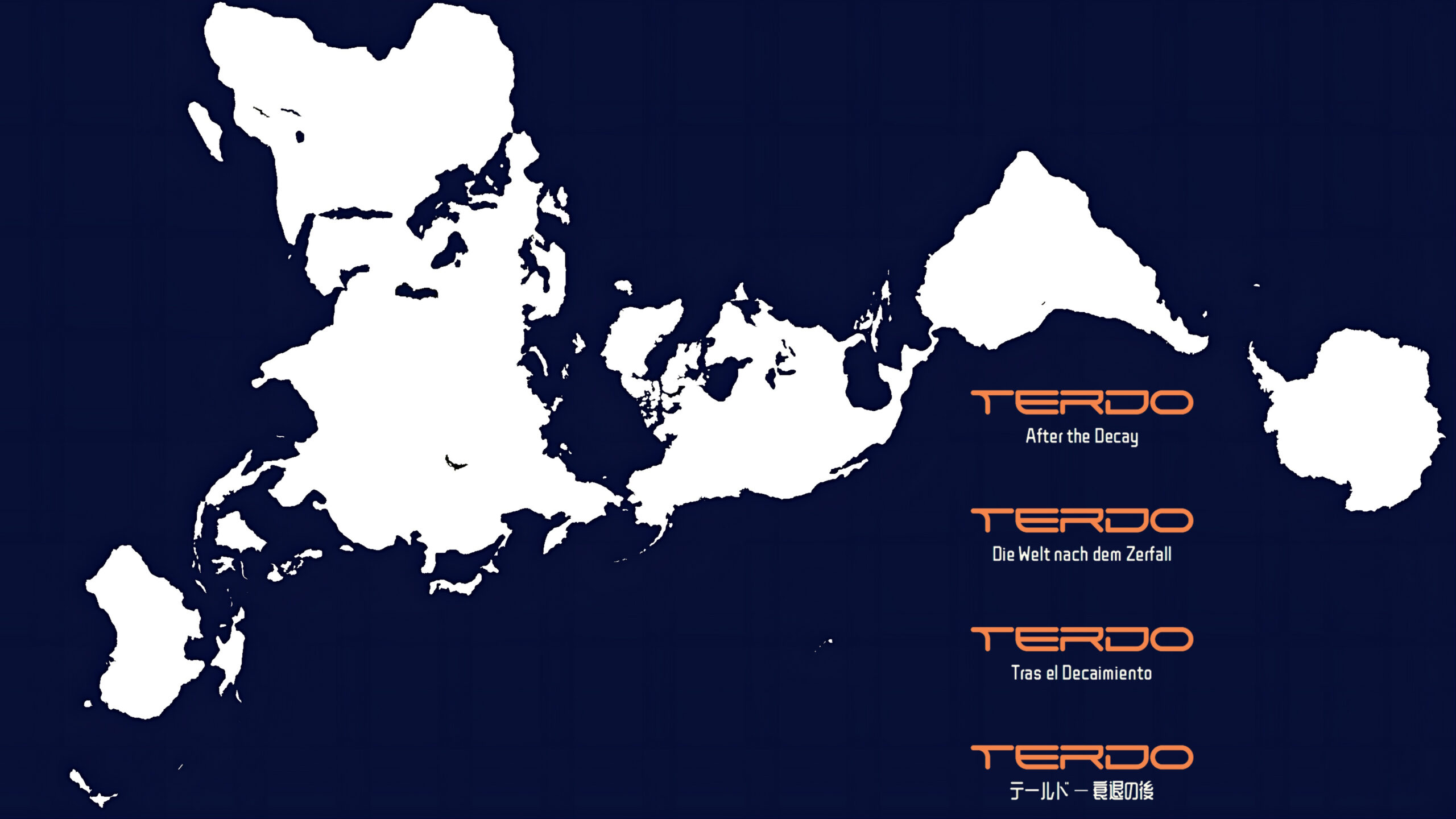
The world after the Decay is fragmented, yet stable. Based on scientific research, historical patterns, and educated assumptions, we identified several regions that were most likely to remain habitable and eventually develop into new societies. These regions have been given new names, but they are far from resembling the nation states we know today.
The Gallery in the main menu will gradually become a collection of all backgrounds, animations, and artwork featured in the game. To help players understand how profoundly the world has changed, we also decided to include a map unlike the ones we are familiar with today. Like the entire user interface of Terdo – After the Decay, this map presents Earth through the eyes of the Terdo.
Creating a believable world map from scratch would have been a massive undertaking, so we chose to base ours on the Dymaxion projection. You can see the map at the beginning of this post. Its unfamiliar perspective reinforces the feeling that this is both our world—and one that has changed beyond recognition.
Here is a list of the regions that will play a role throughout Terdo—After the Decay:
Runa Pacha
Runa Pacha is located on the Altiplano in the Andes of present-day Peru and Bolivia. The area lies high above sea level and has traditionally been inhabited by the Quechua and Aymara peoples. This region has suffered the least from global wars but was hit hard by the effects of volcanic eruptions, which led to crop failures and millions of deaths. Runa Pacha is where Andrés Mamani comes from, the first character players will encounter.
Nagaya
Nagaya lies in the highlands of present-day Ethiopia. After being torn apart by wars driven by the interests of foreign superpowers, the region fell into chaos, and the survivors had to make peace with their past of uprisings, civil wars, and ethnic cleansing. Unknown to the rest of the world, a new culture emerged that set new standards in philosophy and science. In admiration of the local people and their achievements, the Terdo chose to build a city there. Nagaya will play a major role in the second half of the game.
Virunga & Kivu
This beautiful mountain region lies west of the East African Rift System. It is so secluded and remote that war never reached it. It became a fertile refuge for displaced people from across Africa and a last sanctuary for wildlife fleeing the devastation of the lowlands. One of the four playable characters, a female doctor, comes from this region.
Lesotho & Maloti
The high Drakensberg Mountains will serve as the setting for one of the game’s side stories.
Papua
The island of Papua New Guinea is today one of the most culturally diverse places on Earth, home to several hundred peoples and languages, as well as an extraordinary biodiversity. At one point in the story, the player will depend on collaborating with the local communities, who have been neglected for centuries by outside powers that considered themselves superior.
Tasmania
The island south of mainland Australia is the home of one of the four playable characters, a female engineer.
New Canterbury (Aotearoa)
After the eruption of Taupō on the North Island, the South Island becomes the last refuge for the Māori, the people of New Zealand, and refugees arriving from North America, Japan, Korea, and the Philippines. Technologically, this is the most advanced region in Terdo—After the Decay, which is why the Terdo originally planned to settle there. However, corruption and ongoing misunderstandings ultimately lead them to turn away and choose Nagaya as their new home instead. The city of New Canterbury is the largest city on the planet and home to the last of the four playable characters.
Karpaty
This region in the mountains of present-day Romania will play a role in one of the game’s side stories.
Worldbuilding for Terdo—After the Decay has never been about creating the darkest possible future. Our goal was to imagine a world that has endured centuries of hardship and still found ways to rebuild, adapt, and move forward.
Every region, every culture, and every conflict in the game is rooted in this timeline. While players will only experience a small part of this history directly, we believe that a believable world begins long before the story itself.
We hope this small glimpse behind the scenes gives you an idea of how much thought has gone into shaping the world of Terdo—After the Decay. As always, we’d love to hear what you think—and which region you’re most curious to explore.
Schreibe einen Kommentar