
I am an ambitious person. I always challenge myself. Whatever I start doing, I want to do it properly.
Inventing the Terdo for Terdo – After the Decay ment doing something that had been done a thousand times before. I had no clear idea of what they looked like, but I did have a specific idea about some of their biological functions—does that sound weird?
What I wanted to say is this: I was never ambitious enough to create a species that is completely unlike anything we’ve ever seen in science fiction. I don’t mind if the Terdo remind you of another species. In fact, I would be surprised if they didn’t.
There are only so many ways to imagine intelligent alien life. There’s even a scientific debate about what extraterrestrial life may look like. Some scientists argue that life on other planets is likely to resemble life on earth, based on carbon, need for oxygen etc. You may, thus, have to say goodbye to your idea of interdimensional giant snails floating through the galaxy.
Others disagree such as the American astronomer Carl Edward Sagan. They see possibilities in life based on other elements depending on the conditions given on the particular planet. Mr. Sagan would probably accuse me of carbon chauvinism if he was still alive. In case you didn’t know: that’s actually a thing.
Anyway, here is what came to my mind several months ago when it all started.
I came up with a species that has three biological sexes. That idea was essential from the very beginning, and it never changed. I imagined them slightly taller than humans. I thought of them as a species that evolved from something resembling amphibian reptiles. Or reptilian amphibians. Whatever kind of creature that mixture would produce on a far-away planet, I imagined it as their ancestor.
I also imagined their evolution taking place close to water, making them more dependent on it than we are.
After a while, I had a fairly clear idea of what they could be like and checked that idea with ChatGPT. Why? Because I wanted to make sure that I wasn’t settling for for the first sci-fi cliché that came to mind. I’m clearly not Stanisław Lem, but I wanted at least try to write hard sci-fi and chatting with an A.I.-entity turned out to be a useful tool for checking the boundaries of my ideas.
According to A.I., a species with three biological sexes is not entirely implausible from an evolutionary perspective. Take, for example, Schizophyllum commune better known as the Split Gill mushroom. This little fungal fellow has more than 23,000 mating types.
Imagine a speed dating.
„Oh, you’re 8,945 and I’m 11,073. Bummer. I mean, we can still make out, but I was looking for a wife and kids and all…“
So, after validating my idea with A.I. and the cosmos in general, I started writing the first chapter of Terdo. Eventually, I realised that I needed a reason why a highly advanced species would need help from humankind. I think I found a solution to that question, but I don’t want to spoil the plot of my visual novel.
Or do I?
Well, in case you don’t want to know more about it, STOP reading NOW.
Otherwise, you’ve been warned.
Here are my first notes about the Terdo, scribbled together in February 2026. If you scroll further down, you will find a showcase with an early design concept. Let me know what you think in the comments.
BTW: You will get to know one Terdo character in a future update, so make sure you don’t miss it.
Appearance of the Terdo
- Highly advanced species with three biological genders.
- Height: Approximately 200 to 230 cm.
- Greyish-pink skin [comment: that actually changed, they’re yellowish now], slightly mottled; strong skin reactions (changes in color and pattern) depending on mood, discomfort, arousal, aggression, etc.
- Elongated skeleton, long neck, slender and narrow build.
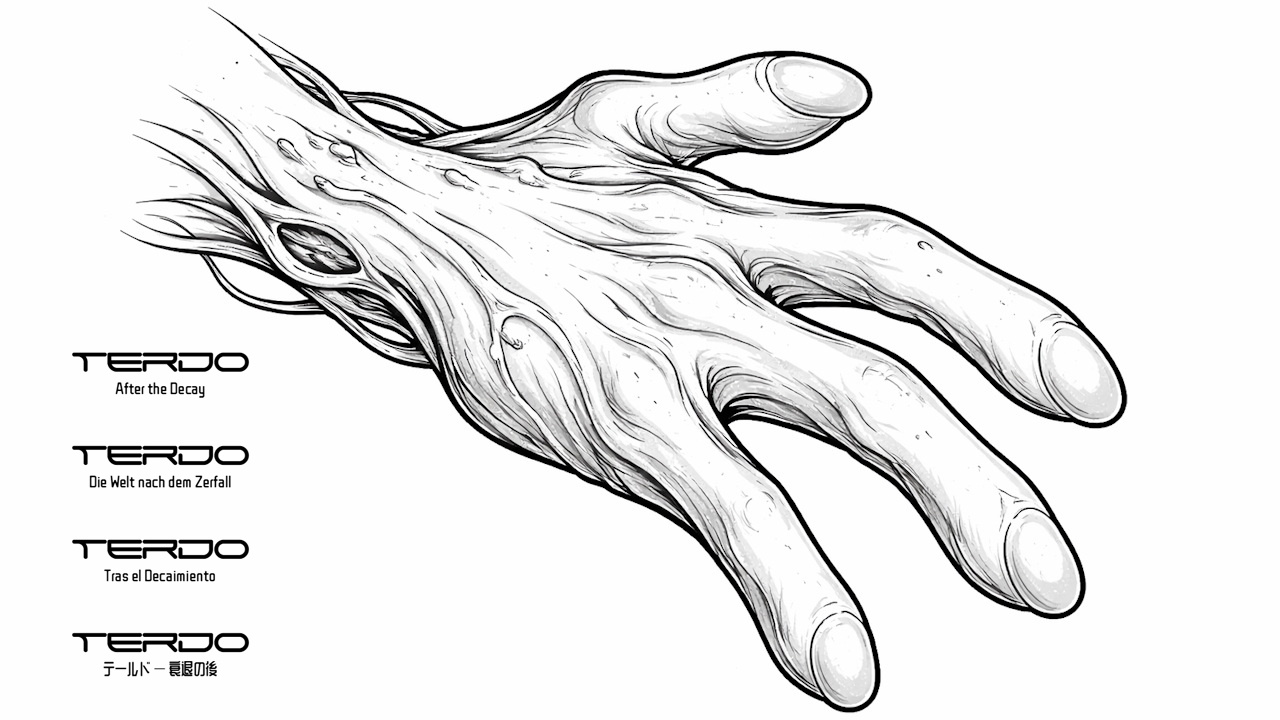
- Four limbs; hands with three fingers and a thumb; recessed webbing in the lower third of the fingers.
- Very hard white fingernails that partially wrap around the fingertips.
- Toes are fused with membranes (webbed feet).
- Oval-shaped, enlarged occiput (back of the head).
- Long, flat, slightly ridged forehead.
- High hairline [comment: that changed for now, no hair, or at least: best shaving technique of the galaxy].
- Subtle noses with slit-shaped, curved openings.
- Pheromone opening on the forehead for intense sensory perception.
- Vestiges of scales, primarily on the back along the spine, on the shoulder blades, and on the neck; fused with the endoskeleton on both sides of the spine, providing additional support for the long vertebral column.
- Well-developed and clearly visible musculature with very little subcutaneous fat.
- Very large lung capacity; lungs are connected to the skin and most organs via a complex system of tracheae. However, these tracheae no longer serve oxygen transport (cutaneous respiration was likely lost early in evolution); instead, the stigma-like openings in the skin absorb micronutrients and deliver them directly to the organism.
- On their home planet (Golo), they absorb particles and micronutrients from the atmosphere and especially from the water, which contribute significantly to their vitality. The accumulation of various complex mineral-organic compounds in the skin, outer layers of muscle, and hair gives the Terdo a shimmering, iridescent appearance in sunlight. Due to the lack of these compounds on Earth (they cannot be synthesized), life expectancy and vitality are reduced, particularly in the third gender.
- Life expectancy: 150 to 180 years (on Earth), 220 to 260 years (on Golo).
Evolution of the Terdo
- Evolved from amphibian-like creatures on the planet Golo.
- Habitat and lifestyle of early ancestors: Mangrove forests and swamps.
- Likely lived in groups; formerly omnivores with a predominantly plant-based diet (especially sea and underwater plants), molluscs, and insects.
- Highly differentiated visual acuity and pressure sensitivity of the skin for detecting predators in murky water.
- Limited hearing ability.
- Early ancestors lived near bodies of water in structures made of plant matter or natural cavities.
- Likely possessed the ability for underwater respiration (via the skin) in an early evolutionary phase.
Early prototype
As we made clear in an earlier post, we’re using A.I.-generated graphics to create Terdo. Writing a good prompt takes time, and if you’re aiming for a specific design, it takes a great deal of experience to achieve consistent results.
Have a look at these four prototypes to learn more about how the appearance of the Terdo evolved.
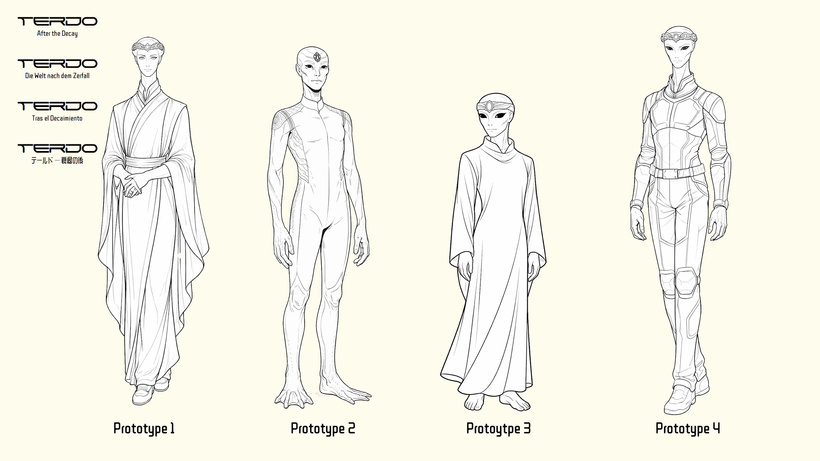
Prototype 1 is the elven version of what I originally imagined. I liked the almost aura-like appearance, but there was simply too much Galadriel in this early design.
With the prompt that resulted in Prototype 2, I aimed to incorporate more visible signs of the Terdo’s unique evolutionary background. The feet were tempting to keep, but I ultimately considered them impractical and implausible for a species that would eventually develop space travel and establish settlements on other planets.
Prototype 3 paved the way toward what I wanted to achieve, although I still felt that something was missing.
Prototype 4 finally became the blueprint for the Terdo. I used it as a visual reference for many later designs. You can clearly see that the A.I. consistently retained the tiara-like headpiece (that’s an important part of Terdo culture, more details to come). Most importantly, this version gave me the impression of a species that is both mysterious and plausible, while also feeling scientifically advanced.
As you can see, working with A.I. is not an easy shortcut. It takes time, and even when you achieve a satisfying result, you still need to refine it, adjust it, and turn it into the artwork you actually want for your game.
You may also have noticed that these are only black-and-white line drawings. This is part of our specific workflow for creating character blueprints that can still be refined and shaped by hand later on.
In one of our upcoming posts, I will tell you more about the development of our character styles.
Schreibe einen Kommentar